Searching for charming Yorkshire villages that haven’t been turned into tourist traps? The Yorkshire Wolds offers something increasingly rare: authenticity. Stone cottages line quiet streets, proper village pubs serve locals who’ve drunk there for decades, and you can actually park your car without circling for forty minutes. The Yorkshire Wolds holds over 100 villages and several market towns, each with their own character, from the ‘Capital of the Wolds’ at Driffield to remote Thixendale sitting in its deep dry valley.
Here’s what frustrates many visitors about village guides: they list places alphabetically with generic descriptions copied from Wikipedia, or they only feature the obvious spots everyone already knows about. This guide goes deeper—covering the villages with Britain’s tallest standing stone, the estate village built entirely to serve one grand house, the hamlet that inspired David Hockney’s paintings, and the market town where you can still watch a medieval charter market in action. What follows isn’t tourist board fluff—it’s practical information about what makes each village worth visiting, what the limitations are, and how to make the most of your time in this corner of Yorkshire.
Whether you’re planning a walking holiday along the Yorkshire Wolds Way, searching for the prettiest villages in East Yorkshire, or simply want to base yourself somewhere peaceful for exploring the gentle countryside, this guide covers everything. You’ll find detailed information about the major market towns with proper facilities, the most beautiful villages for photographers, the best historic settlements for heritage lovers, and hidden gems where you might be the only visitor all day. Ready to discover why these Yorkshire Wolds villages deserve a spot on your travel list? Let’s start with the big players.
Major Market Towns of the Yorkshire Wolds
The market towns serve as practical bases for exploring the Wolds, offering accommodation, restaurants, shops, and transport links while maintaining genuine Yorkshire character. These aren’t sanitised tourist towns—they’re working communities with real personality.
Driffield (Great Driffield): Capital of the Wolds
Population: Around 13,000
Best For: Central base, market town atmosphere, history lovers
Market Day: Thursday
Locals call Driffield the “Capital of the Wolds” and they’re not wrong. This is the largest settlement in the Yorkshire Wolds and it genuinely feels like the heart of the region. The Saxons established it centuries ago, with “Derefeld” appearing in the Domesday Book back in 1086. By 1251 it had earned a market charter, and that Thursday market still runs today—proper stalls selling everything from fresh vegetables to work boots, not artisan candles and overpriced fudge.
Walking through Driffield, you’ll spot All Saints Church, standing since the 12th century with its 500-year-old tower watching over everything. The Georgian houses along Market Place and Middle Street show the town’s prosperous past, all neat lines and symmetry. The train station opened in 1846 and still serves visitors today, making Driffield one of the few Wolds settlements easily reached by public transport.
Where to Eat & Drink:
- Frankies Cafe (River Head) – Sits beside the old canal dock with lovely views. Reviews praise their breakfasts and friendly service.
- The Mariner’s Arms – Traditional pub with Yorkshire hospitality
- Bell Hotel – Historic coaching inn, good for meals
What to Do:
- Thursday market (the real deal, not a farmers’ market)
- All Saints Church architecture
- Walk the old canal path
- The Driffield Show (July) – one of Britain’s biggest one-day agricultural shows
Accommodation: Wide choice from budget B&Bs to country hotels. The White House cottage is particularly nice for couples wanting self-catering with a hot tub.
Getting There: Direct trains from Hull, Scarborough, Bridlington. By car: A614 or A166. Free parking in town centre car parks.
Local Tip: The Driffield Showground hosts events year-round. Check what’s on before visiting—anything from vintage tractor rallies to dog shows might coincide with your trip.
Market Weighton: The Geographic Heart
Population: Around 6,500
Best For: Central location between Hull and York, walking access
Market Day: Wednesday (small)
Market Weighton sits almost exactly 20 miles from both Hull and York, making it brilliantly practical if you want to explore cities and countryside in one trip. The Romans were here first, then the town gained its official market charter in 1251 from King John.
The town’s most famous resident was William Bradley, who at 7 feet 9 inches became the tallest Englishman on record. A statue of him stands in the town centre, and he remains a source of local pride. Market Weighton offers genuine market town character—butchers, bakers, independent shops, the occasional charity shop, and a community that actually lives here rather than just passing through.
Where to Eat & Drink:
- Wolds Way Cafe (Driffield Road) – Hearty breakfasts and homemade cakes with solid visitor reviews (4.5/5 rating)
- The Londesborough Arms – Comfortable pub, good for meals
- Half Moon Inn – Traditional market town pub
What to Do:
- All Saints Church (beautiful interior)
- Walk the Hudson Way (traffic-free trail)
- Yorkshire Wolds Way passes nearby
- Visit Londesborough Park Estate
- Wednesday farmers’ market (seasonal, check dates)
Accommodation: Several B&Bs and pubs with rooms. More budget-friendly than Driffield generally.
Getting There: Limited train service. Better by car via A1079 or A614. Bus connections to York, Hull, and Beverley.
Local Tip: The farmers’ market is worth timing your visit around if you’re interested in proper local produce rather than tourist-focused artisan markets.
Pocklington: The Gateway Town
Population: Around 8,500
Best For: York day trips, good facilities, arts scene
Market Day: Tuesday
Pocklington feels different from Driffield and Market Weighton—slightly more refined, closer to York’s orbit, with a surprisingly vibrant arts community. The market town dates back to the Domesday Book, and its Tuesday market has run for over 750 years.
The town spreads along a ridge with views across the Vale of York. On a clear day, York Minster is visible from several spots around Pocklington. The town has proper facilities: Tesco, independent shops, cafes serving decent coffee, and enough restaurants to keep visitors interested for several days.
Where to Eat & Drink:
- The Feathers Hotel – Historic coaching inn, good food
- The Station Hotel – Despite the name, the station closed in 1965, but the pub’s still solid
- Nineteen21 – Modern British restaurant, surprisingly good for a market town
- Various cafes along the main street
What to Do:
- Burnby Hall Gardens (famous water lily collection, genuinely spectacular in summer)
- Pocklington Arts Centre (cinema, theatre, exhibitions)
- All Saints Church (14th century tower)
- Tuesday market
- Walk to nearby villages like Millington
Accommodation: Good range including the Feathers Hotel, several B&Bs, and holiday cottages in surrounding villages.
Getting There: Bus connections to York (regular), Hull, Beverley. By car: A1079 from York (15 minutes). Limited parking in town centre but several car parks.
Local Tip: Burnby Hall Gardens is often underrated by visitors. July and August offer peak water lily displays—the collection is genuinely impressive and usually remains relatively quiet.
Beverley: The Minster Town
Population: Around 30,000
Best For: Historic architecture, shopping, nightlife, western Wolds base
Market Day: Saturday (main), Wednesday
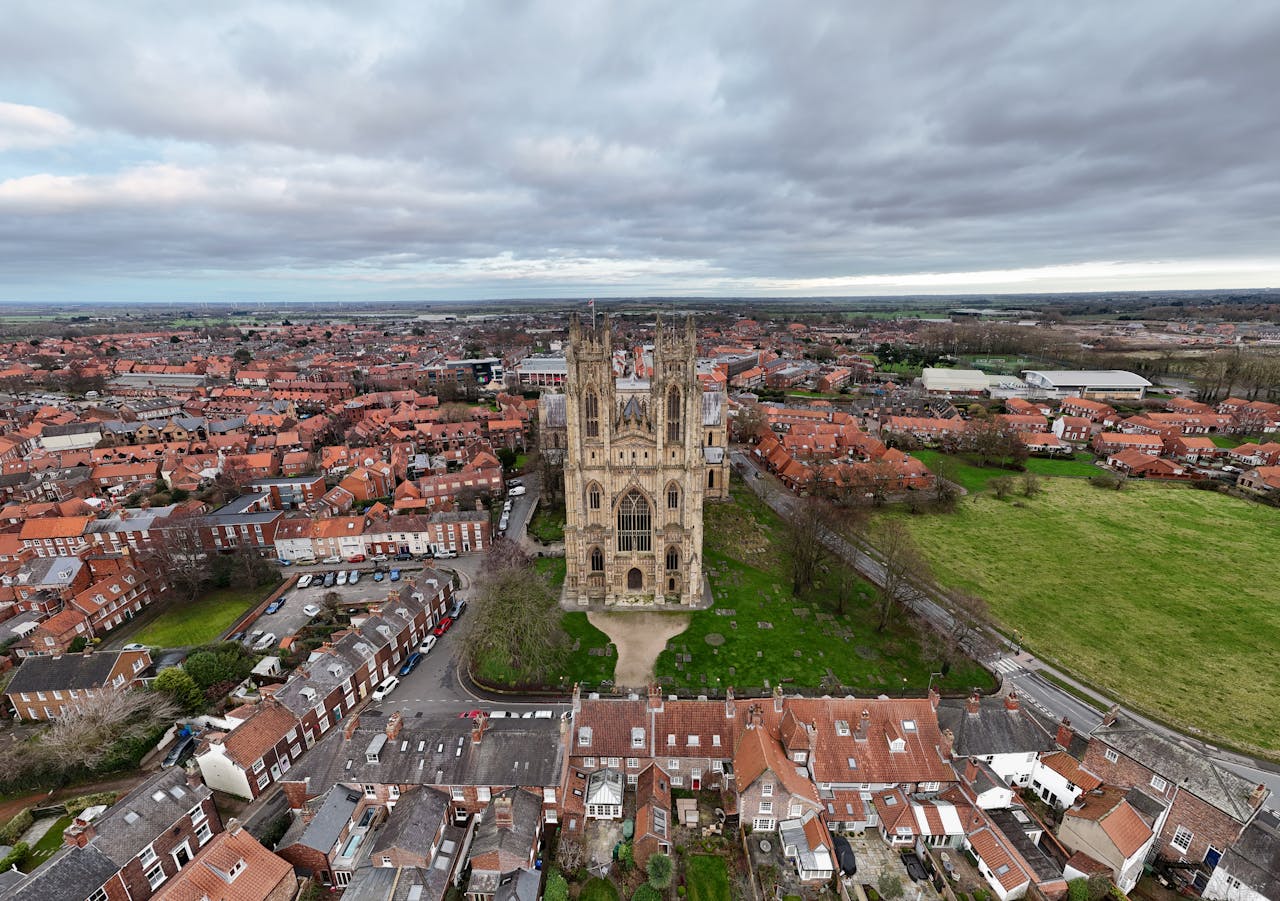
Technically Beverley sits on the western edge of the Yorkshire Wolds rather than in them, but it’s too important to skip. This is the major town for the area, and it’s genuinely beautiful—one of England’s finest market towns, though its popularity means it attracts considerable tourist traffic.
Beverley Minster dominates everything, a Gothic masterpiece that rivals many cathedrals. The town’s medieval street pattern survives intact, lined with Georgian houses, independent shops, and a notable concentration of pubs.
Where to Eat & Drink:
- Dozens of options from chain restaurants to independent cafes
- The Westwood – Excellent gastropub
- Pipe and Glass Inn (nearby) – Michelin-starred pub
- Saturday market has good food stalls
What to Do:
- Beverley Minster (free entry, stunning)
- St Mary’s Church (another architectural gem)
- Saturday market (huge, busy, traditional)
- Beverley Westwood (common land for walking)
- Independent shops and galleries
- Regular festivals and events
Accommodation: Everything from Premier Inn to boutique hotels and B&Bs. Book ahead for weekends and festival times.
Getting There: Train station with regular services to Hull, York, and beyond. By car: A1079, A164, or A1035. Several car parks but can be busy weekends.
Local Tip: If Beverley feels too busy (Saturday market especially), visit midweek. Tuesday and Wednesday mornings have the historic charm without the crowds.
The Most Beautiful Villages
These villages regularly appear on “prettiest in Yorkshire” lists, and having visited them repeatedly, I understand why. They combine stunning settings, good architecture, and that intangible quality that makes you want to stop and stay awhile.
Millington: Hockney’s Inspiration
Population: Around 200
Best For: Stunning scenery, walking, artistic types, peace
Three miles north-east of Pocklington, Millington sits in classic Yorkshire Wolds landscape. David Hockney painted here repeatedly, drawn by the light, the rolling hills, and the way the landscape layers into the distance. Walking the paths around Millington reveals why this area captured his artistic attention.
The village clusters around a small green with the church, a few farms, and houses that look like they’ve grown naturally from the landscape. Paths lead through Millington Wood and up onto the hills, offering panoramic views across the Great Wold Valley. On a clear day, York Minster is visible glinting in the distance.
Where to Eat & Drink:
- The Gait Inn – Village pub, proper Yorkshire welcome, good food
- Ramblers Rest Tearoom – Cosy spot, homemade cakes, popular with walkers
What to Do:
- Walk Millington Wood (bluebells in spring, stunning)
- Circular walks around the village (3-8 miles)
- Photography (seriously, you’ll take hundreds of photos)
- Wildflower spotting (chalk grassland species)
Accommodation: Limited in village itself. Holiday cottages nearby, or stay in Pocklington.
Getting There: By car only really. Narrow lanes, limited parking in village—use designated walker parking areas.
Local Tip: Early morning or late afternoon offers the best light for photography. The shadows and colours shift dramatically throughout the day—timing similar to when Hockney would have worked.
Thixendale: The Remote Valley Village
Population: Around 100
Best For: Complete escape, serious walkers, solitude
Thixendale sits in a deep dry valley, surrounded by hills on all sides. Getting here requires commitment—narrow winding roads that make satnavs questionable, and once there, the village is genuinely remote. No shop, one pub, a small church, and that’s about it.
But that remoteness is exactly the point. The village attracts walkers tackling the Yorkshire Wolds Way (which passes through) and people who genuinely want to disconnect. Six dry valleys meet here, creating a landscape that feels dramatic despite the Wolds’ generally gentle reputation.
Where to Eat & Drink:
- The Cross Keys – Only pub, traditional, walkers welcome, does basic accommodation
What to Do:
- Walk literally anywhere (multiple valleys to explore)
- Yorkshire Wolds Way passes through
- Several circular routes (5-10 miles)
- Simply enjoy the quiet
Accommodation: The Cross Keys has rooms. Otherwise, holiday cottages in the village or surrounding farms.
Getting There: By car only. From Driffield or Malton via narrow lanes. Not suitable for large vehicles. Very limited parking.
Local Tip: Mobile signal can be non-existent. Don’t plan on “popping out” for forgotten items. Bring everything needed and embrace the isolation that makes Thixendale special.
Sledmere: The Estate Village
Population: Around 400
Best For: Architecture lovers, families, Sledmere House visitors
Sledmere is an estate village, built by the Sykes family to serve Sledmere House. That planned origin is evident—the village has a cohesive architectural character, with well-maintained stone buildings and neat gardens.
The village sits on the Yorkshire Wolds Way and attracts visitors to Sledmere House (East Yorkshire’s finest country house). But even without the grand house, Sledmere village itself merits exploration, with its Eleanor Cross memorial, beautiful church, and traditional village layout.
Where to Eat & Drink:
- Coach House Cafe (at Sledmere House) – Doesn’t require house admission, good food
- Triton Inn – Village pub, traditional
What to Do:
- Sledmere House, gardens, and museums (separate guide in main article)
- Village architecture walk
- Eleanor Cross (memorial to Sir Tatton Sykes)
- St Mary’s Church
Accommodation: Holiday cottages on the estate. Otherwise Market Weighton or Driffield.
Getting There: By car via B1253 or B1252. Limited bus service. Car park at Sledmere House (free for cafe).
Local Tip: Visiting during one of Sledmere House’s events—outdoor theatre, craft fairs, music performances—adds extra interest. The estate grounds remain open during these occasions.
Warter: The Pretty Estate Village
Population: Around 200
Best For: Quiet stay, walking, traditional village atmosphere
Warter sits in a shallow valley with the Warter Priory estate surrounding it. Like Sledmere, it’s an estate village, but it feels less formal, more genuinely lived-in. The village pond, the stone cottages, and the setting among gentle hills create picture-postcard Yorkshire.
The village appeared in the Domesday Book, and evidence of medieval life surrounds it. The church combines Norman and later architecture, and walking the footpaths reveals traces of the old priory and estate features.
Where to Eat & Drink:
- The Wellington Inn – Traditional pub, good food, friendly
What to Do:
- Village walks (pond, church, old priory grounds)
- Longer walks into surrounding hills
- St James Church
- Simply enjoy the peace
Accommodation: Holiday cottages in village and nearby farms. Limited but high quality.
Getting There: By car via B1246. Very limited public transport. Small amount of roadside parking.
Local Tip: Warter Priory (now offices) isn’t open to the public, but public footpaths run through the estate grounds—offering access to beautiful parkland without needing special permission.
History Buff’s Villages
These villages offer rich historical interest beyond pretty scenery. From Britain’s tallest standing stone to Iron Age chariot burials, these settlements reveal layers of Yorkshire’s past.
Rudston: Britain’s Tallest Standing Stone
Population: Around 400
Best For: Prehistoric mystery, unusual sights, history lovers
Rudston village has one genuinely extraordinary feature: a 25-foot tall monolithic standing stone in the churchyard—the tallest in Britain. Dating to around 2500 BC, this massive stone predates the church by over 3,500 years.
Nobody knows for certain how Neolithic people transported this enormous stone (weighing around 40 tons) or what ceremonies took place around it. The stone’s alignment and the concentration of prehistoric monuments nearby suggest Rudston was a significant ceremonial site.
Early Christians often built churches at pagan sacred sites—either to “Christianise” them or because these locations already held spiritual significance for local populations. All Saints Church literally surrounds the ancient stone, creating a fascinating juxtaposition of Christian and prehistoric belief.
The mysterious Gypsey Race stream flows through Rudston village too, adding to the mystical atmosphere.
Where to Eat & Drink:
- The Bosville Arms – Traditional village pub, good food
What to Do:
- Rudston Monolith (free, in churchyard)
- All Saints Church (usually open)
- Walk the Gypsey Race
- Prehistoric burial mounds in surrounding fields (visible from footpaths)
Accommodation: Limited in village. Nearby Bridlington (5 miles) has full range.
Getting There: By car via B1253. Limited bus service from Bridlington.
Local Tip: The Rudston Monolith stands in the churchyard and is free to visit anytime. Early morning or late afternoon typically means fewer visitors and better light for photography.
Kilham: The Original Capital
Population: Around 1,000
Best For: Village life, local facilities, history
Before Driffield claimed the title “Capital of the Wolds,” Kilham held that distinction. This is a proper working village—not a tourist destination, not an estate village, just a genuine Yorkshire Wolds community that’s been here for centuries.
The village appears in the Domesday Book and served as an important market centre for centuries. Today it maintains that working character—agricultural, practical, unpretentious.
Kilham offers more facilities than most small Wolds villages: shop, primary school, pub, regular bus service. It’s the kind of place you’d actually want to live, not just visit.
Where to Eat & Drink:
- The Old Star Inn – Traditional pub, locals’ favourite
- Village shop for supplies
What to Do:
- All Saints Church (medieval architecture)
- Explore working village character
- Use as practical base for Wolds walking
- Market cross and village features
Accommodation: Some B&Bs and holiday cottages in village and surrounding farms.
Getting There: B1253 or B1249. Better bus service than most Wolds villages.
Local Tip: Kilham works well as a practical base rather than a destination in itself. The village offers proper facilities—shop, pub, transport links—while providing access to explore the wider Wolds area.
Burton Agnes: The Tudor Hall Village
Population: Around 300
Best For: Architecture lovers, gardens, Tudor history
Burton Agnes is completely dominated by Burton Agnes Hall—one of England’s finest Elizabethan houses. Built 1601-1610, the hall remains in private ownership and opens to visitors.
The village itself clusters around the hall entrance, with estate cottages and the Norman church creating a picturesque setting. It’s smaller and quieter than Sledmere but shares that estate village character.
Burton Agnes Hall features:
- Elizabethan architecture (ornate façade, grand rooms)
- Impressive art collection
- Beautiful gardens
- Café
- Seasonal events
The hall operates independently from the National Trust, giving it personality sometimes lacking in more corporate heritage sites.
Where to Eat & Drink:
- Café at Burton Agnes Hall
- The Wold Cottage (nearby) – Excellent gastropub
What to Do:
- Burton Agnes Hall (main attraction, admission charged)
- Gardens and grounds
- St Martin’s Church (Norman)
- Village walk
Accommodation: Limited in village. Driffield (5 miles) or Bridlington (6 miles) for range.
Getting There: Off A614 between Driffield and Bridlington. Limited public transport.
Local Tip: Combining Burton Agnes Hall with lunch at The Wold Cottage makes for an excellent day out. The gastropub has a strong reputation and sits just outside the village.
Wetwang: The Village with the Memorable Name
Population: Around 700
Best For: Iron Age history, quirky name appeal, proper village facilities
Let’s address the obvious: yes, Wetwang is a real place, and yes, the name amuses everyone. It derives from Old Norse “vaett-vangr” meaning “field for the trial of a legal action” or possibly “wet field”—less funny but more historically accurate.
Beyond the name, Wetwang has genuine archaeological significance. The Wetwang Slack site revealed spectacular Iron Age chariot burials around 400-200 BC. These graves contained:
- Complete chariots buried with the deceased
- High-status grave goods
- Evidence of elaborate burial ceremonies
- Insights into Iron Age warrior culture
The British Museum displays some finds from Wetwang, including the famous “Lady of Wetwang” chariot burial.
Modern Wetwang is a working village with good facilities—shop, primary school, pubs, regular bus service. It makes a practical base for exploring the Wolds.
Where to Eat & Drink:
- The Black Swan – Traditional village pub
- The Blue Bell – Another pub option
- Village shop
What to Do:
- Learn about Iron Age chariot burials (information boards in village)
- Use as practical base for Wolds exploration
- Village church (St Nicholas)
- Nearby walking routes
Accommodation: Some B&Bs in village and surrounding area.
Getting There: A166 York to Driffield road. Good bus service on this route.
Local Tip: The chariot burial site itself is on private farmland and not publicly accessible, but the village has interpretation boards about the archaeological discoveries. The actual finds are displayed in museums rather than in Wetwang itself.
Walker’s Favourites
These villages sit on or near the Yorkshire Wolds Way, making them natural stops for walkers. They combine practical facilities with beautiful surroundings.
Huggate: High Village, High Views
Population: Around 150
Best For: Walkers, views, peaceful base, traditional village
Huggate sits at one of the highest points in the Yorkshire Wolds at around 550 feet above sea level. That elevation means views—on clear days, visibility extends for miles across the rolling chalk landscape.
The village straddles the Yorkshire Wolds Way, making it a natural stop for long-distance walkers. But even for those not tackling the full 79 miles, Huggate makes an excellent base for day walks radiating across the high Wolds.
The village has genuine traditional character—stone cottages, working farms, a proper village pub, and that sense of a community that’s been established for centuries rather than recently discovered by tourists.
Where to Eat & Drink:
- The Wolds Inn – Traditional pub, walkers welcome, good food, accommodation
- No shop (nearest Pocklington or Driffield)
What to Do:
- Walk the Yorkshire Wolds Way (passes through village)
- Circular walks onto surrounding wold tops
- St Mary’s Church (12th century Norman features)
- Simply enjoy the high Wolds atmosphere
Accommodation: The Wolds Inn has rooms. Some holiday cottages nearby.
Getting There: Minor roads off A166 or B1246. No public transport.
Local Tip: The Wolds Inn has an excellent reputation as a proper village pub that welcomes walkers without being overly tourist-focused. Accommodation books well ahead for summer weekends.
Fridaythorpe: The Crossroads Village
Population: Around 200
Best For: Walking base, Wolds Way access, facilities
Fridaythorpe sits where the Yorkshire Wolds Way crosses the A166 York to Bridlington road. This crossroads position makes it a practical stop—public transport access (buses on A166), walking route access, and relative ease of reaching by car.
The village serves walkers well: pub with accommodation, shop, tearoom (seasonal), and that essential combination of facilities and Wolds Way proximity. The Fridaythorpe to Thixendale section of the Yorkshire Wolds Way is one of the trail’s highlights, with dramatic valley scenery.
Where to Eat & Drink:
- The Crown and Anchor – Village pub, walker-friendly
- Village shop and café (check opening times)
What to Do:
- Yorkshire Wolds Way walks (north to Thixendale or south toward Huggate)
- Circular walks onto surrounding hills
- Practical base for Wolds exploration
Accommodation: Crown and Anchor has rooms. Holiday cottages in area.
Getting There: A166, good bus service (Coastliner York-Bridlington route). Car access easy.
Local Tip: The bus service on the A166 makes Fridaythorpe useful for linear Yorkshire Wolds Way walks—walk one direction, return by bus. Current timetables should be checked, but the service is generally reliable.
Wold Newton: Literary Connections
Population: Around 150
Best For: Literary history, peaceful setting, walking
Wold Newton gave its name to the “Wold Newton family”—a fictional genealogy created by science fiction writer Philip José Farmer. He imagined that a meteorite strike near Wold Newton in 1795 affected several passing coach passengers, whose descendants became famous fictional characters including Sherlock Holmes, Tarzan, and James Bond.
The real 1795 meteorite strike did happen—the largest meteorite fall recorded in Britain at the time. A monument marks the spot in a field about a mile from the village.
Beyond literary connections, Wold Newton is a peaceful Wolds village with the Gypsey Race flowing through when water levels permit. The duck pond fed by the stream creates an idyllic village scene.
Where to Eat & Drink:
- Limited facilities in village itself
- Nearest proper pub/food in neighbouring villages
What to Do:
- Visit the Wold Newton meteorite monument (short walk from village)
- Village duck pond
- Yorkshire Wolds Way passes nearby
- Gypsey Race stream (when flowing)
Accommodation: Very limited. Holiday cottages occasionally available.
Getting There: Minor roads, B1253 nearby. No public transport.
Local Tip: The meteorite monument sits in a field reached by public footpath from the village. It’s a simple stone marker, but the story—and the literary connections Philip José Farmer built from it—adds considerable interest.
South Cave (Revisited for Walkers)
Already covered in the market towns section, but worth emphasizing South Cave’s appeal for walkers. The village sits at the western edge of the Wolds where the chalk meets the plain, creating a transitional landscape that’s different from the high Wolds.
The Yorkshire Wolds Way passes near South Cave, and the village offers:
- Good accommodation range
- Decent pubs and restaurants
- Shop and facilities
- Public transport (buses to Hull)
- Walking routes into the Wolds or to North Cave Wetlands
South Cave works as either a first night (after Hessle start) or last night (before Filey finish) for Wolds Way walkers, or as a base for exploring the western Wolds area.
Hidden Gems
These lesser-known villages offer peace, beauty, and that sense of discovering somewhere tourists haven’t found yet.
Fimber: Remote and Unspoiled
Population: Around 100
Best For: Complete peace, remote walking, escape
Fimber sits in a remote dry valley, accessed by narrow winding lanes that discourage casual visitors. This is about as peaceful as the Yorkshire Wolds gets—a tiny village surrounded by rolling hills, with minimal facilities and maximum tranquility.
The village forms part of the proposed Area of Outstanding Natural Beauty designation area, which tells you how special Natural England considers this landscape. Walking routes from Fimber explore classic dry valley scenery without crowds.
There’s almost nothing here—no pub, no shop, just a church, a few farms, and cottages. That’s exactly the point.
Where to Eat & Drink:
- Nothing in village
- Nearest facilities Sledmere or Driffield (both 8-10 miles)
What to Do:
- Walk the surrounding dry valleys
- Enjoy complete peace
- Church visit (usually open)
- Wildlife watching
Accommodation: Very occasional holiday cottage. Otherwise stay elsewhere and visit.
Getting There: Minor roads only, narrow and winding. Not suitable for large vehicles. No public transport.
Local Tip: Bring everything needed—water, food, fully charged phone. There are no facilities in Fimber, and that complete absence of amenities is the entire appeal for those seeking genuine solitude.
Nunburnholme: Valley Peace
Population: Around 100
Best For: Historic church, peaceful valley, traditional village
Nunburnholme sits in a pretty valley with a genuine gem: St James Church. This small medieval church contains exceptional medieval stone carvings and a peaceful atmosphere that rewards the detour.
The village name derives from “Nun’s Burn” (a stream) and “holme” (water meadow), describing its valley setting perfectly. The little stream still flows through, creating a genuinely picturesque Yorkshire Wolds village.
Poet Francis Palgrave lived here—he compiled “The Golden Treasury,” one of the most influential English poetry anthologies. The village has quiet literary connections alongside its medieval architecture.
Where to Eat & Drink:
- No pub currently (check status—rural pubs open/close)
- No shop
- Nearest facilities Market Weighton or Pocklington
What to Do:
- St James Church (medieval carvings, peaceful setting)
- Valley walks
- Simply absorb the peace
Accommodation: Occasional holiday cottage. Otherwise nearby towns.
Getting There: Minor roads off A1079 near Market Weighton. No public transport.
Local Tip: The church is the highlight. Medieval stone carvings of exceptional quality in a tiny village church—the kind of craftsmanship that would draw crowds in a cathedral but here can often be appreciated in solitude.
North Dalton and South Dalton: Twin Villages
Population: North Dalton ~200, South Dalton ~300
Best For: Architecture, estate villages, paired exploration
These twin villages sit a few miles apart, both estate villages with distinctive characters. South Dalton particularly impresses with its planned layout and stunning church.
South Dalton was redesigned as an estate village in the 19th century. St Mary’s Church (1858-61) is an architectural masterpiece—one of the finest Victorian churches in the country, built by the Hotham family who owned the estate. The church’s Gothic Revival architecture and beautiful setting make it worth a special trip.
North Dalton is quieter and less formal than its southern neighbour but has charm and a proper village pub.
Where to Eat & Drink:
- Star Inn (North Dalton) – Good village pub
- South Dalton has limited facilities
What to Do:
- St Mary’s Church, South Dalton (architectural masterpiece)
- Village architecture appreciation
- Countryside walks between the two villages
- North Dalton village character
Accommodation: Limited. Holiday cottages occasionally. Use Beverley or Market Weighton as base.
Getting There: Minor roads off A164. Limited public transport.
Local Tip: St Mary’s Church in South Dalton is genuinely stunning architecture. Church architecture enthusiasts shouldn’t miss this Victorian masterpiece. North Dalton’s pub makes a good lunch stop when visiting both villages.
Kirkburn: Saxon Church Treasures
Population: Around 300
Best For: Church architecture, history, peaceful setting
Kirkburn might be small but St Mary’s Church punches well above its weight historically. This church contains one of the finest Norman fonts in England—intricately carved with scenes and figures, dating to around 1150.
The village sits quietly away from main roads, maintaining traditional character. It’s the kind of place you discover by accident or through specific interest rather than passing through.
Where to Eat & Drink:
- Limited village facilities
- Nearest Driffield (5 miles)
What to Do:
- St Mary’s Church (Norman font is exceptional)
- Village exploration
- Peaceful countryside walks
Accommodation: Occasional cottage rental. Otherwise nearby Driffield.
Getting There: Minor roads near Driffield. No public transport.
Local Tip: The Norman font is extraordinary—deeply carved with religious and decorative scenes. Bringing a torch is advisable; church lighting might not illuminate the carved details effectively. The church is usually open during daylight hours.
Practical Village Guide
Now for the practical stuff: which villages have what facilities, and how to choose where to base yourself.
Villages with Pubs
Currently Operating Pubs:
- Driffield: Multiple pubs
- Market Weighton: Several pubs
- Pocklington: Multiple options
- Beverley: Lots of pubs
- Sledmere: The Triton Inn (gastropub, seasonal)
- Millington: The Gait Inn
- Thixendale: The Cross Keys
- South Cave: Multiple pubs
- Huggate: The Wolds Inn
- North Dalton: Star Inn
- Rudston: The Bosville Arms
- Wetwang: Black Swan, Blue Bell
- Fridaythorpe: Crown and Anchor
- Kilham: Old Star Inn
- Warter: The Wellington Inn
Note: Rural pubs open and close. Always check current status before relying on a pub for food or accommodation.
Villages with Shops
Proper Village Shop:
- Driffield: Supermarkets, multiple shops
- Market Weighton: Supermarkets, shops
- Pocklington: Full shopping
- Beverley: Complete town shopping
- Kilham: Village shop
- Wetwang: Village shop
- Fridaythorpe: Small shop (check hours)
Farm Shop Only:
- Sledmere: Farm shop at Sledmere House (seasonal)
No Shop:
- Most smaller villages have no shop. Plan accordingly.
Villages with Accommodation
Good Range:
- Driffield, Market Weighton, Pocklington, Beverley, Filey
Limited but Available:
- Sledmere (Triton Inn, estate cottages)
- Thixendale (Cross Keys, cottages)
- Millington (Gait Inn possibility, cottages)
- Huggate (Wolds Inn, cottages)
- South Cave (several options)
- Fridaythorpe (pub rooms, cottages)
Very Limited:
- Most smaller villages: occasional holiday cottage but book well ahead
Villages by Interest Type
For History Lovers:
- Rudston (prehistoric monolith)
- Wetwang (Iron Age discoveries)
- Burton Agnes (Tudor hall)
- Kirkburn (Norman font)
- Wharram Percy (deserted medieval village—technically not inhabited)
For Walkers:
- Thixendale (Yorkshire Wolds Way, remote)
- Millington (stunning scenery, walks)
- Huggate (high Wolds, views)
- Fridaythorpe (Wolds Way crossroads)
- Sledmere (Wolds Way, facilities)
For Families:
- Sledmere (house, farm park, playground, café)
- Pocklington (Burnby Hall Gardens, facilities)
- Beverley (minster, parks, attractions)
- Burton Agnes (hall, gardens)
For Peace/Escape:
- Fimber (ultra-remote)
- Thixendale (isolated valley)
- Nunburnholme (quiet valley)
- Warter (peaceful estate village)
For Practicality:
- Driffield (central, facilities, transport)
- Market Weighton (central, good links)
- Pocklington (facilities, York access)
- Beverley (western base, city amenities)
Best Bases for Exploring
Central Wolds:
- Driffield (good all-round)
- Market Weighton (central position)
- Sledmere (if using car, beautiful setting)
High Wolds Walking:
- Huggate (walker-focused)
- Thixendale (remote but authentic)
- Millington (stunning scenery)
Western Edge:
- South Cave (accessible, facilities)
- Beverley (proper town, Wolds edge)
Budget Conscious:
- Market Weighton (cheaper than Beverley)
- Driffield (good value generally)
- Smaller villages (if you find cottage deals)
Without a Car:
- Beverley (best public transport)
- Driffield (train station)
- Market Weighton (bus links)
- Don’t choose tiny villages—you’ll be stuck
Village Events and Traditions
Annual Events
The Kiplingcotes Derby (March) Held near Market Weighton since 1519, the Kiplingcotes Derby is England’s oldest horse race. This isn’t Royal Ascot—it’s a quirky, muddy, agricultural cross-country race run on a Thursday in March. Utterly traditional and wonderfully eccentric.
Driffield Show (July) One of Britain’s biggest one-day agricultural shows. Proper Yorkshire agricultural show—livestock, machinery, local produce, sheepdog trials. Not a farmers’ market with artisan bread; an actual working agricultural show.
Sledmere House Events (Various) Throughout summer: outdoor theatre, classic cars, craft fairs, garden events. Check Sledmere House website for schedule.
Village Fêtes Many villages hold summer fêtes—typically August. Small-scale, community-focused, sometimes charmingly amateur. Check local village websites or notice boards.
Seasonal Highlights
Spring (April-May)
- Wildflowers on chalk grassland
- Lambing season on farms
- Lighter evenings for walking
Summer (June-August)
- Vibrant poppy fields (June/July)
- Village fêtes and shows
- Longest days for exploring
Autumn (September-October)
- Harvest time
- Autumn colours
- Quieter villages as tourists diminish
Winter (November-March)
- Christmas markets in Beverley
- Gypsey Race flowing (maybe)
- Peace and solitude (and cold)
Planning Your Yorkshire Wolds Village Tour
Suggested Itineraries
Weekend Break (2-3 Days)
Day 1: Base in Driffield or Market Weighton. Explore your base town, visit Sledmere House and village, walk surrounding countryside.
Day 2: Drive to Millington for morning walk and Hockney landscapes. Lunch at The Gait Inn. Afternoon in Thixendale (prepare for narrow lanes). Dinner back at your base.
Day 3: Rudston for the standing stone, Burton Agnes Hall if open, or explore smaller villages like Warter or Huggate before heading home.
Week-Long Tour (7 Days)
Day 1: Arrive Beverley, explore minster and town.
Day 2: Move to Pocklington, visit Burnby Hall Gardens, walk to Millington.
Day 3: Thixendale day trip, Yorkshire Wolds Way walking.
Day 4: Move to Driffield base, explore market town, Sledmere afternoon.
Day 5: Rudston, Burton Agnes, Wetwang circuit by car.
Day 6: High Wolds villages—Huggate, Fridaythorpe, walking.
Day 7: South Cave, North Cave Wetlands, return journey.
Walking the Villages (Yorkshire Wolds Way)
The 79-mile Yorkshire Wolds Way connects many villages naturally:
- Hessle to South Cave (11.5 miles)
- South Cave to Market Weighton area (12-13 miles)
- Market Weighton to Millington (10-12 miles)
- Millington to Thixendale (13 miles)
- Thixendale area to Weaverthorpe area (12-14 miles)
- Continue to Filey (see Yorkshire Wolds Way guide)
This allows village-to-village exploration on foot, experiencing the landscape between settlements.
How to Choose Your Base
If you want:
- Best facilities: Driffield, Beverley, or Pocklington
- Central location: Market Weighton
- Most beautiful setting: Millington or Sledmere (book early)
- Walking focus: Thixendale, Huggate, or Millington
- Public transport access: Beverley or Driffield
- Budget option: Market Weighton or smaller village cottage
- Family-friendly: Pocklington (Burnby Hall) or Sledmere (attractions)
Length of stay by base:
- Beverley: 2-3 nights (it’s on the edge, you’ll drive into Wolds daily)
- Driffield/Market Weighton: 3-5 nights (central, explore different areas)
- Smaller villages: 2-4 nights (peaceful but limited facilities)
- Multiple bases: Move every 2-3 nights to experience different areas
Transport Considerations
With a Car: You have complete flexibility. Most villages require a car to reach practically. Plan routes accounting for narrow lanes in places like Thixendale and Fimber.
Without a Car:
- Base in Beverley, Driffield, or Pocklington
- Use buses along A166 (York-Bridlington route) for Fridaythorpe, Wetwang access
- Taxis for villages off bus routes (expensive but sometimes necessary)
- Consider Yorkshire Wolds Way walking to connect villages
- Accept you’ll miss the most remote villages
Cycling: The Yorkshire Wolds offers excellent cycling—rolling hills, quiet lanes, beautiful scenery. Road bikes work on main routes; gravel bikes better for exploring minor roads. Several villages connect via Sustrans cycle routes.
When to Visit
Best Overall: May, June, or September
- Good weather likely
- Accommodation available (book ahead still)
- Not too crowded
- Gardens and countryside looking good
Peak Season: July-August
- Warmest weather, longest days
- Most expensive accommodation
- Some villages busier (though never overwhelming)
- Vibrant poppy fields in early July
Shoulder Season: April, October
- Cheaper accommodation
- Quieter villages
- Weather more variable
- Some attractions closed/limited hours
Winter: November-March
- Very quiet, some villages feel deserted
- Limited facilities, some pubs/accommodation closed
- Short days challenging for exploration
- Can be atmospheric but also bleak
Costs
Daily Budget (Per Person):
Budget: £40-60
- Pub lunch or packed lunch (£8-12)
- Modest dinner (£10-15)
- Minimal attractions
Mid-Range: £80-120
- Good B&B or cottage (£60-80)
- Café lunch (£10-15)
- Decent pub dinner (£20-30)
- Attraction entries (£10-20)
Comfortable: £150-200+
- Boutique accommodation (£100-140)
- Quality meals (£40-60)
- Multiple attraction entries
- Activities, souvenirs
Weekly Costs:
- Budget: £280-420 (plus transport)
- Mid-Range: £560-840 (plus transport)
- Comfortable: £1,050-1,400+ (plus transport)
Travelling as a couple or group reduces per-person accommodation costs significantly.
Frequently Asked Questions
Which Yorkshire Wolds village should I visit first?
For first-time visitors, Millington offers stunning scenery and excellent walking, while Sledmere provides the full stately home experience plus a beautiful village. For practicality and authentic market town atmosphere, Driffield is hard to beat.
Can I visit Yorkshire Wolds villages without a car?
Possible but limiting. Beverley and Driffield have train/bus access. From there, buses serve some villages along main roads (particularly the A166). However, the most beautiful villages—Millington, Thixendale, Fimber—require a car or serious commitment to walking. Taxis are an option but expensive for visiting multiple villages.
Are the villages child-friendly?
Generally yes. Sledmere specifically caters to families with its farm park and playground. Most villages welcome children in pubs (especially at lunch times). Accommodation varies—some B&Bs don’t accept children, others welcome families. The countryside offers safe outdoor space. Don’t expect specific child attractions in tiny villages though.
Which villages are dog-friendly?
Most Yorkshire Wolds villages welcome dogs. Pubs generally allow dogs (check specific venues), footpaths are dog-friendly, and accommodation often accepts dogs (usually with a supplement). Dogs must be kept on leads near livestock. The countryside is excellent for dog walking.
How many villages can I visit in a day?
Realistically: 3-4 villages if just driving through and stopping briefly. 2-3 if actually exploring each properly (walking, pub lunch, attraction visits). Trying to tick off too many means spending all day driving narrow lanes and missing what makes these places special.
Are Yorkshire Wolds villages expensive?
Compared to the Cotswolds or Lake District, no. Compared to Northern England generally, they’re mid-range. Accommodation ranges from budget B&Bs to boutique options. Pub meals are reasonable (£10-20 mains typically). Attraction entry where charged follows standard UK pricing. Overall, decent value for countryside tourism.
When are villages most photogenic?
Early morning (6-8am) for mist in valleys and soft light. Late afternoon/evening (golden hour) for warm light on stone cottages. June-July for vibrant poppy fields. Autumn for colours. Midday harsh light should be avoided. Spring brings wildflowers. Each season offers different photographic opportunities.
Do I need to book restaurants in advance?
In tiny villages with one pub, yes—especially for dinner on Friday/Saturday. Market towns generally have walk-in availability but booking ensures choice. Summer weekends fill up faster. Lunch is usually easier than dinner. Calling ahead is recommended when visiting specifically for a meal.
Can I visit church interiors?
Most Yorkshire Wolds churches stay open during daylight hours for visitors. A few lock for security but display information about key holders. Visitors should remember that these are working churches—services take priority, photography might be restricted, donations are appreciated. The churches generally welcome respectful visitors.
What’s the mobile phone signal like?
Variable. Villages on main roads generally have adequate signal. Remote valleys (Thixendale, Fimber) can have patchy or no signal. Don’t rely on phones for navigation in remote areas—bring OS maps. Inform someone of your plans when heading to isolated villages.
Conclusion: Discovering Yorkshire Wolds Villages
The Yorkshire Wolds villages offer remarkable variety within a compact area. There’s no single “best” village—the ideal choice depends entirely on what visitors seek.
Driffield provides practical facilities and market town character. Thixendale offers remote peace in a stunning valley. Sledmere combines estate grandeur with Wolds walking access. Millington brings David Hockney’s painted hills to life. Rudston features Britain’s tallest standing stone in a churchyard. Wetwang combines a memorable name with serious Iron Age archaeology.
The beauty of the Yorkshire Wolds villages lies in their variety within a small area. Visitors can base themselves in Driffield or Market Weighton and explore completely different village types within 30 minutes’ drive. Walking the Yorkshire Wolds Way connects villages naturally, revealing how the landscape shapes each settlement.
These aren’t Cotswolds villages with coach tours and inflated prices. They’re not Lake District honeypots with impossible parking. They’re working Yorkshire communities, estate villages with centuries of careful planning, and remote hamlets that tourism hasn’t discovered. That relative obscurity is exactly what makes them special.
The Yorkshire Wolds villages are waiting. The market towns offer practical Yorkshire hospitality. The estate villages showcase Georgian planning at its finest. The tiny hamlets hide in peaceful valleys. And all of them sit in that gentle chalk landscape that rewards exploration.
Your favourite Yorkshire Wolds village is out there waiting to be discovered.
Ready to explore more of the Yorkshire Wolds?
- Yorkshire Wolds: Your Complete Guide to East Yorkshire’s Rolling Chalk Hills – Return to main guide
- Yorkshire Wolds Way: Complete Walking Guide – Walking route through these villages
- Sledmere Village and Sledmere House: Complete Guide – Detailed estate village guide
- Kirby Grindalythe: Complete Village Guide – Historic Wolds village
- Best Walks in the Yorkshire Wolds – Circular walks from villages
- Triton Inn Sledmere Review – Pub in Sledmere
Planning Resources:
- Visit East Yorkshire – Official tourism information
- National Trail – Yorkshire Wolds Way information
- Individual village websites (where they exist)
- OS Explorer Maps 300 and OL27