There’s something about the start of a new year that makes you look around your house and think, “How did I accumulate all this stuff?”
Christmas doesn’t help, does it? You’ve just received gifts (lovely as they are), the decorations are still creating clutter, and you’re probably eyeing all the things you haven’t used in months, thinking, “Why do I still have this?”
I used to think decluttering meant becoming some sort of minimalist with three spoons and a capsule wardrobe. But over the years, I’ve learned that decluttering is just about making your space work for you – not living up to someone else’s idea of what your home should look like.
So here’s my approach to new year decluttering that’s actually sustainable and won’t leave you regretting getting rid of half your belongings.
There’s a FREE deluttering challenge PDF checklist at the end.
- Why January is Perfect for Decluttering
- The Problem with Extreme Decluttering
- My Decluttering Philosophy
- Getting Started: The Mental Shift
- Room-by-Room Decluttering Guide
- Digital Decluttering
- What to Do With Everything You’re Getting Rid Of
- Maintaining a Clutter-Free Space
- When Decluttering Affects Mental Health
- Free Decluttering Checklist
- Final Thoughts
Why January is Perfect for Decluttering
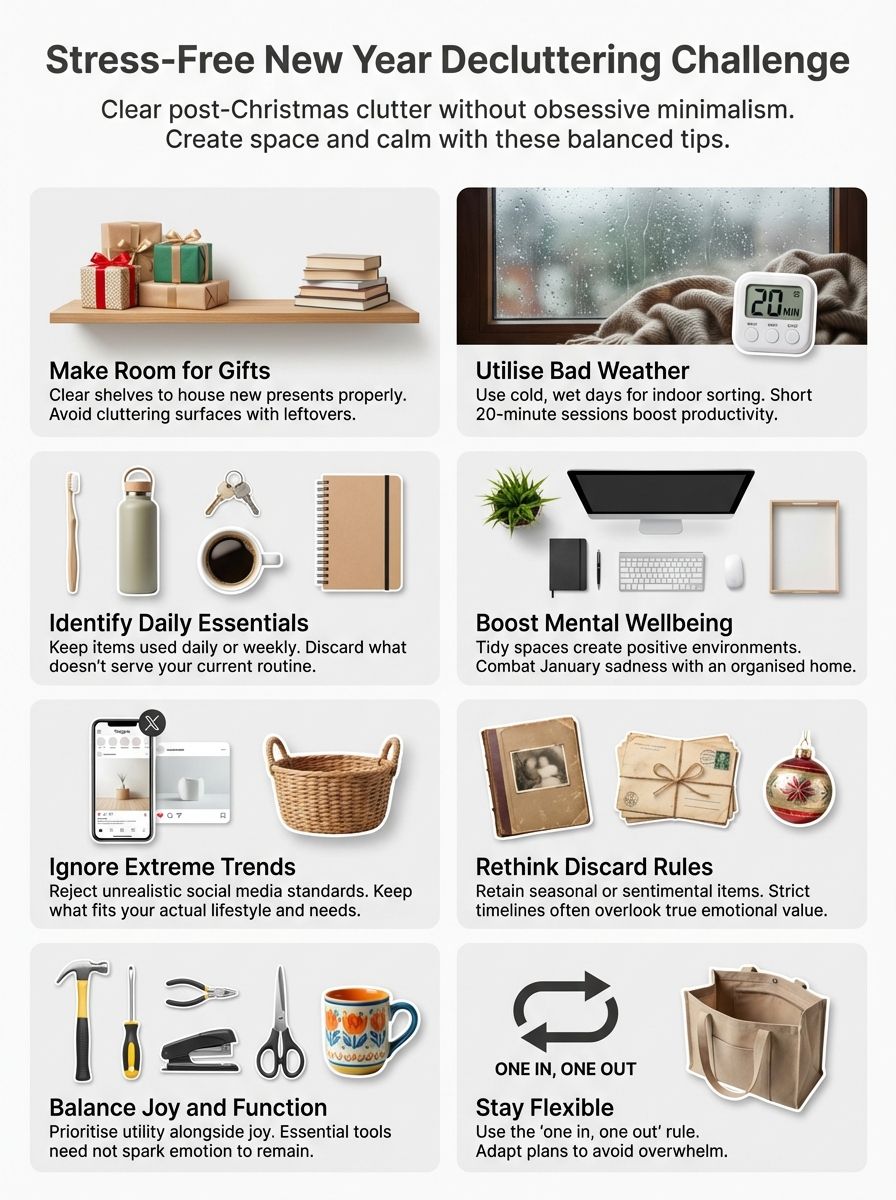
Let me be honest – I’m not usually a fan of starting ambitious projects in January when it’s cold and dark and I’d rather be under a blanket. But decluttering is actually one of the few things that works well this time of year.
You’ve Just Acquired More Stuff
Christmas means new things coming into your home. To make room for them, something else probably needs to go. It’s basic physics, really – you can’t keep adding to a space indefinitely without it becoming overwhelming.
You’re Inside Anyway
When it’s freezing outside and dark by 4 pm, you’re spending more time indoors. You might as well use that time to make your space more pleasant to be in.
It Creates a Sense of a Fresh Start
I know “fresh start” is a bit of a cliché, but there genuinely is something satisfying about clearing out the old to make way for the new. It feels proactive when winter can otherwise feel relatively stagnant.
It Reveals What You Actually Use
After the festive period, it becomes obvious what you reach for regularly and what’s just taking up space. That fancy kitchen gadget you got three Christmases ago and used once? Yeah, you can probably let that go.
It Helps With the January Blues
Having a clear, organised space genuinely affects your mental health. When your environment feels chaotic, your mind often feels chaotic too. Decluttering gives you something tangible to focus on when everything else feels a bit rubbish.
The Problem with Extreme Decluttering
Before we get into the practical stuff, can we talk about how toxic the decluttering industry has become?
The Minimalism Pressure
Social media is full of people with completely empty, white, minimalist homes: no personality, no clutter, nothing out of place. And look, if that’s genuinely your style, brilliant. But for most of us, that’s not realistic or even desirable.
I have hobbies. I have interests. I have a kid. My house is never going to look like a hotel room, and that’s fine. Your home should reflect your life, not some aesthetic ideal.
The Purging Mentality
There’s this idea that you should get rid of anything you haven’t used in six months. But that’s nonsense for a lot of things.
I don’t use my Christmas decorations for 11 months of the year – should I bin them? I don’t wear my winter coat in summer – should I get rid of it? What about sentimental items, or things you might need occasionally, or hobbies you do seasonally?
Life isn’t that black and white.
The Marie Kondo Effect
I actually quite like Marie Kondo’s approach, but it got twisted into this idea that if something doesn’t “spark joy,” it has to go. But what about the plunger? The fire extinguisher? The boring but necessary items that keep your life functioning?
Not everything needs to be joyful. Some things just need to be useful.
Declutter Regret
I’ve gotten rid of things in overzealous decluttering sessions that I later regretted. A coat I thought I’d never wear again became perfect two years later. Books I donated, thinking I’d never reread them. Kitchen items I had to rebuy.
Rushing to declutter everything often leads to having to replace things, which wastes money and creates more waste.
My Decluttering Philosophy
So what’s a better approach? Here’s what works for me:
Declutter to Serve Your Life
The goal isn’t to have less stuff. The goal is to have a space that works for how you actually live.
If you love reading and have shelves full of books, that’s not clutter – that’s your interest taking up space in your home, which is exactly what should happen.
If you have craft supplies you use regularly, they’re not clutter. If you have craft supplies from hobbies you abandoned three years ago, they probably are.
Create Space for What Matters
Instead of focusing on what to get rid of, think about what you want space for.
Want more room for your growing collection of houseplants? Clear out something else. Want a proper work-from-home setup? Maybe that unused exercise bike needs to go.
You’re not decluttering for the sake of it – you’re making room for the things that actually enhance your life.
Keep What You Use and Love
If you use it regularly or genuinely love it, keep it. End of story.
You don’t need to justify why you still have your favourite mug collection, or your childhood teddy, or that book you haven’t read yet, but still want to.
Be Honest About Aspirational Stuff
This is the tough one. We all have things we keep for the person we aspire to be rather than the person we are.
That gym equipment you never use because you prefer walking. Those fancy kitchen gadgets for the gourmet chef you’re not. Those clothes from three sizes ago “just in case.”
It’s okay to let go of aspirational items that are just making you feel guilty.
One In, One Out (Sort Of)
I don’t rigidly follow the one-in-one-out rule, but it’s useful as a guideline. When something new comes in, consider whether something similar can go out.
New coat? Maybe donate the old ones you never wear. New book? Perhaps pass one on to a friend. It keeps things from accumulating endlessly.
Getting Started: The Mental Shift
Before you start pulling everything out of cupboards, sort your headspace out first.
Set Realistic Expectations
You’re not going to transform your entire house in one weekend. Unless you live in a tiny studio flat, this will take time. And that’s fine.
Aim for progress, not perfection.
Decide Your Approach
There are two main ways to declutter:
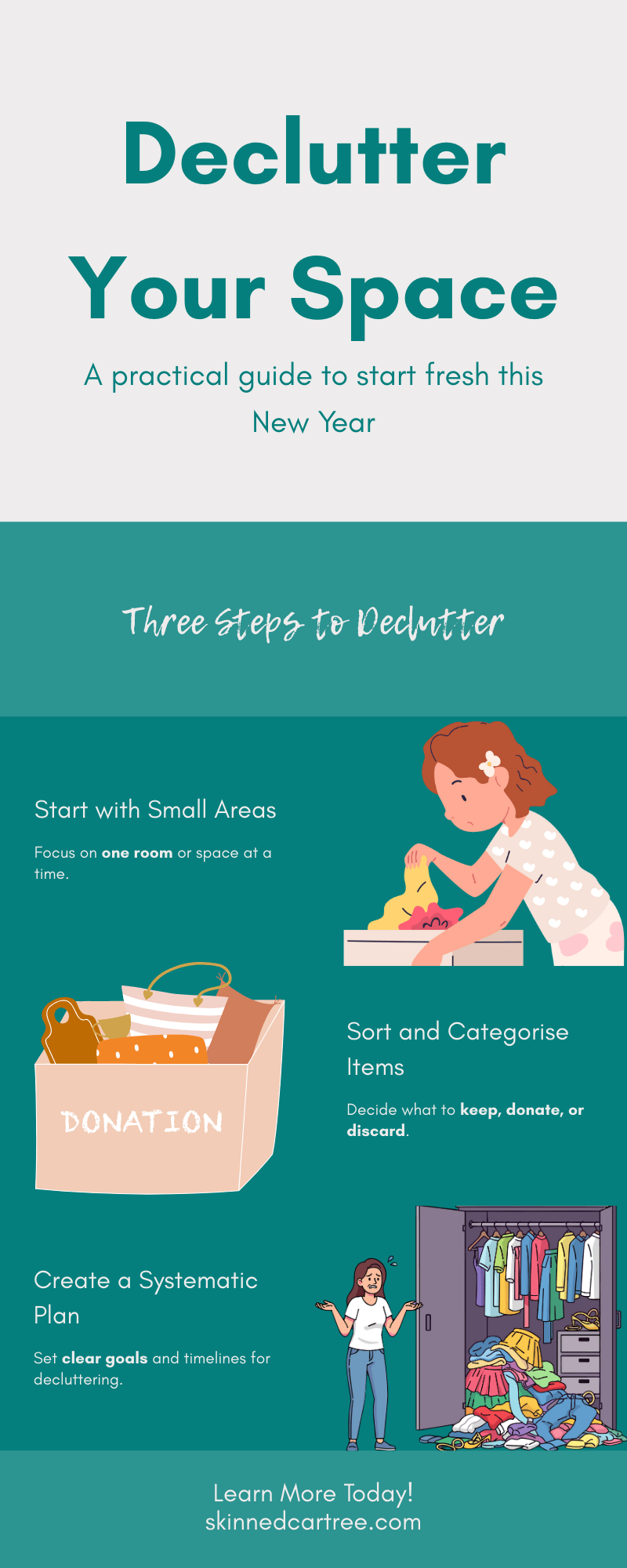
Room by room: Work through one room at a time until it’s done, then move to the next.
Category by category: Deal with all your books at once, all your clothes at once, etc., regardless of which room they’re in.
I prefer room by room because I like seeing a complete space finished, but some people swear by category. Pick whatever feels more manageable to you.
Get Sorting Supplies
You’ll need:
- Boxes or bags for sorting
- Labels (even just sticky notes)
- Bin bags
- Cleaning supplies
I use four categories: Keep, Donate, Sell, and Bin. Some people add “Maybe” for things they’re unsure about.
Choose Your Starting Point
Don’t start with the most emotionally difficult area. Don’t begin with your memory boxes or family heirlooms.
Start somewhere neutral and satisfying – maybe the bathroom, or the kitchen gadgets drawer. Get some wins under your belt before tackling the harder stuff.
Set a Timer
Decluttering can be overwhelming if you try to do too much at once. Set a timer for 30 minutes and just work for that time. You’ll be surprised how much you can achieve.
If you’re on a roll when the timer goes off, great, keep going. But knowing there’s an endpoint makes it less daunting to start.

Room-by-Room Decluttering Guide
Right, let’s get practical. Here’s how to tackle each area of your home.
Kitchen
The kitchen often holds the most random accumulation of stuff.
Start with:
- Expired food in cupboards and fridge (check those dates!)
- Duplicate utensils (do you really need five wooden spoons?)
- Broken or missing-part items
- Gadgets you’ve never used or used once
- Mismatched Tupperware (and lids with no containers)
- Chipped or cracked dishes
- Takeaway cutlery and sauce packets
Keep:
- Things you use at least monthly
- One good set of pans/knives/utensils
- Enough plates/bowls/glasses for your household, plus a few extra for guests
- Speciality items you genuinely use (even if only occasionally)
Questions to ask:
- When did I last use this?
- Could I borrow it if I needed it?
- Is it worth the space it takes up?
- Would I buy it again if I didn’t already own it?
My kitchen declutter: I had so many random kitchen gadgets – an egg poacher I’d used once, three different types of graters, special pans for things I never made. Getting rid of them freed up loads of cupboard space, and honestly? I haven’t missed any of them.
Living Room
This is often the dumping ground for everything that doesn’t have a proper home.
Start with:
- Old magazines and newspapers
- Broken electronics or remotes to things you no longer own
- DVDs and CDs you’ll never watch/listen to again
- Books you’re not interested in reading
- Decorative items you don’t actually like
- Excess cushions and throws
- Kids’ toys that are broken or outgrown
Keep:
- Things that make the room comfortable and functional
- Items you genuinely love looking at
- Entertainment you actually use
- Enough seating for your regular use
Questions to ask:
- Does this add to or detract from how I want this room to feel?
- Is this here because I like it or because I think I should have it?
- When did I last actually use this?
Storage tip: If your living room feels cluttered but everything in it is used, you might need better storage rather than getting rid of things. Baskets for toys, a coffee table with storage, wall shelves – think about solutions before you purge.
Bedroom
Your bedroom should be a calm, restful space. Hard to achieve when there’s stuff everywhere.
Start with:
- Clothes you haven’t worn in over a year (with exceptions for special occasions)
- Clothes that don’t fit (be honest)
- Worn-out underwear and socks with holes
- Bedding you never use
- Books piled on bedside tables that you’re not reading
- Cosmetics and skincare you don’t use
Keep:
- Clothes you wear regularly and feel good in
- Special occasion items you’ll genuinely wear again
- Enough bedding for washing rotation
- Items that help you relax and sleep well
Questions to ask:
- Would I wear this if it were clean and at the front of my wardrobe?
- Does this fit my actual lifestyle, not my imagined one?
- Is keeping this “just in case” stopping me from enjoying my space now?
Wardrobe tip: Turn all your hangers backwards. When you wear something, turn the hanger the right way. In six months, you’ll clearly see what you never wear. Consider whether those items should stay.
Bathroom
Bathrooms collect half-used products like nobody’s business.
Start with:
- Expired medications and cosmetics
- Toiletries you don’t like or don’t use
- Excessive towels (you only need about 2-3 per person)
- Empty bottles
- Hotel toiletries you’ll never use
- Old makeup and nail polish
Keep:
- Products you actually use
- Fresh medications
- Enough towels for your household
- Travel-size items you’ll genuinely use
Questions to ask:
- When did I last use this?
- Is this still good? (Most products have a shelf life)
- Do I need three versions of essentially the same thing?
Storage hack: Under-sink storage is your friend. Get some small baskets or drawers to organise, so things don’t just become a chaotic pile where stuff gets lost and forgotten.
Kids’ Rooms (If Applicable)
Children’s spaces can accumulate stuff at an alarming rate.
Start with:
- Broken toys
- Toys with missing pieces
- Toys they’ve outgrown
- Duplicates (how many teddy bears does one child need?)
- Old school work and artwork (keep special pieces, photograph the rest)
- Clothes that don’t fit
Keep:
- Toys they actually play with
- Age-appropriate items
- Special sentimental items
- Enough clothes for regular rotation
Get kids involved: For older children, involve them in decluttering. It teaches them decision-making and means they’re more likely to keep their space tidy. For younger ones, do it when they’re out – they won’t notice half of what goes.
Rotation system: Consider keeping some toys in storage and rotating them. It makes old toys feel new again and keeps the space less overwhelming.
Home Office/Study
If you work from home or have a desk area, it probably needs attention.
Start with:
- Old paperwork (check what you legally need to keep)
- Broken pens and dried-out markers
- Old textbooks or manuals
- Defunct electronics
- Excess stationery
- Random cables to things you no longer own
Keep:
- Current paperwork and files
- Working office supplies
- Reference materials you actually reference
- Items that make your workspace functional
Go paperless: Where possible, scan important documents and store them digitally. You can always print them later if needed, and it saves loads of physical space.
Storage Areas (Loft, Garage, Shed)
These are often where things go to be forgotten.
Start with:
- Actually looking at what’s there (you might have forgotten half of it)
- Obviously broken items
- Things from houses/phases of life ago
- Duplicates stored “just in case”
Keep:
- Seasonal items you use
- Tools and equipment are in good condition
- Properly stored sentimental items
- Things you have concrete plans to use
Be brutal: If you haven’t thought about an item in three years, you probably don’t need it. If you forgot you even had it, that tells you something.
Digital Decluttering
Physical clutter gets all the attention, but digital clutter is just as stressful.
Photos
Your phone probably has thousands of photos, many of which are blurry, duplicates, or of things you don’t care about.
Quick method:
- Set aside an hour
- Go through your photo library month by month
- Delete obvious rubbish (blurry, boring, duplicates)
- Create albums for events and trips
- Back up your favourites to cloud storage
You don’t need 47 photos of the same sunset. Keep your favourite and delete the rest.
Emails
An overflowing inbox is mentally exhausting.
Quick method:
- Delete obvious spam and old emails
- Create folders for important categories
- Archive emails you might need but don’t need to see
- Set up filters to automatically sort incoming mail
Inbox zero isn’t realistic for everyone, but getting it down to a manageable number makes a huge difference.
Apps
Your phone doesn’t need 47 apps you never use.
Quick method:
- Delete apps you haven’t opened in months
- Delete duplicate apps (three weather apps?)
- Remove games you don’t play anymore
- Check app permissions and remove ones you’re uncomfortable with
Your phone will run faster, and you’ll find the apps you actually use more easily.
Files and Downloads
Your computer probably has thousands of random files.
Quick method:
- Go through your downloads folder (it’s probably terrifying)
- Delete old, unused documents
- Organise remaining files into sensible folders
- Delete duplicate files
- Empty your trash/recycle bin
What to Do With Everything You’re Getting Rid Of
Right, you’ve sorted everything. Now what?
Donate
Where to donate:
- Charity shops (clothes, books, homeware in good condition)
- Homeless shelters (toiletries, blankets, coats)
- Schools (craft supplies, books)
- Hospice shops (often take furniture)
- Community groups on Facebook
Make it easy: Don’t let donation bags sit around for months “waiting for a good time” to drop them off. Put them straight in your car, or book a collection, or drop them off on your next shopping trip.
Sell
Worth selling:
- Decent condition electronics
- Designer or high-street clothes
- Children’s items (they sell well)
- Good quality furniture
- Collectables or antiques
Where to sell:
- Facebook Marketplace or local selling groups
- eBay (for collectables or items with broader appeal)
- Vinted or Depop (for clothes)
- Specialist groups (vintage, gaming, etc.)
Be realistic: Most used items aren’t worth as much as you think. If something doesn’t sell quickly, just donate it. Your time and mental space are worth more than the few quid you might get.
Recycle
Check what can be recycled:
- Electronics (many councils have collection points)
- Batteries (most supermarkets have recycling stations)
- Old clothes (textile recycling if not good enough for charity shops)
- Plastic and cardboard (regular recycling)
Don’t just bin things that could be recycled. But also don’t let “I need to find the right place to recycle this” become an excuse to keep clutter.
Bin
Some things just need to go in the bin:
- Broken items beyond repair
- Unhygienic items (old underwear, worn-out towels)
- Things with no alternative disposal method
Don’t feel guilty about this. You tried to use them, they’ve served their purpose, now they’re done.
Maintaining a Clutter-Free Space
The hardest part isn’t the initial declutter – it’s stopping it from building up again.
Deal With Things Immediately
Post comes in? Sort it now. Take out the junk, file what needs keeping, and action what needs actioning. Don’t let it pile up on the side.
Shopping comes home? Put it away properly. Don’t just dump bags in the hallway to “sort later.”
Have a Home for Everything
If something doesn’t have a designated spot, it will end up as clutter. Take the time to create specific homes for items, and always put things back there.
Regular Mini-Declutters
Once a month, do a quick 15-minute declutter of problem areas. Don’t let them build up to the point where it becomes overwhelming again.
Question New Purchases
Before buying something new, ask:
- Do I need this or just want it?
- Where will I keep it?
- What will I get rid of to make space for it?
- Will I still want this in six months?
This doesn’t mean never buying anything, just being more intentional about it.
Seasonal Reviews
Every few months, reassess your spaces. Your needs change, seasons change, your interests change. What worked in January might not work in July.
When Decluttering Affects Mental Health
For some people, decluttering genuinely helps their mental health. For others, it can be triggering or stressful.
When to Take It Easy
If you:
- Feel anxious or overwhelmed at the thought of getting rid of things
- Have sentimental attachments to lots of items
- Are you dealing with grief or loss
- Have conditions like ADHD or anxiety that make decisions difficult
Be extra gentle with yourself. Maybe work with someone supportive, or hire a professional organiser who understands your needs, or just do tiny bits at a time without pressure.
When Keeping Things is Okay
Sentimental items are allowed to take up space. Your deceased grandmother’s tea set doesn’t need to “spark joy” in the traditional sense – it represents something important to you.
Memory boxes are fine. Keeping things “just in case” is sometimes practical, not hoarding.
The difference is when keeping things active makes your life worse rather than better.
When to Get Help
If clutter is:
- Preventing you from using the rooms properly
- Causing relationship problems
- Making you feel constantly overwhelmed
- Creating safety issues
Consider getting professional help, whether that’s a professional organiser, a therapist who specialises in hoarding disorder, or both.
There’s no shame in needing support.
Free Decluttering Checklist
Download the free decluttering checklist here.
Final Thoughts
Decluttering isn’t about creating some perfect minimalist space. It’s about making your home work for you and your actual life.
My house has clutter. I have hobbies, interests, a kid, and a life. Some weeks, my dining table is covered in craft projects. Some days, there are toys everywhere. And that’s fine because it reflects what’s happening in our lives.
But the difference between that and overwhelming clutter is that I know what’s there, it’s mostly stuff we use, and there’s enough clear space to actually live comfortably.
That’s the goal. Not perfection, just functionality and peace of mind.
Start small, be realistic, and remember that your home should serve you, not the other way around.
What’s your decluttering approach? Have you tackled any areas recently? Let me know in the comments!
Related Posts:
- A Realistic Guide to Starting the New Year Right
- Moving to the Countryside: What I Wish I’d Known
- Autumn Living Room Decor Ideas
- Setting New Year’s Goals That Don’t Make You Feel Awful