If you spend any time on Instagram — and let’s be real, most of us spend more than we’d like to admit — you’ve probably noticed that the bar for video content has gone through the roof. Reels that would have looked impressive a year ago now feel basic. The transitions are smoother, the text overlays are cleaner, the pacing is tighter. It’s enough to make you wonder if everyone else secretly went to film school.
They didn’t. What’s actually happened is that AI video editing tools have gotten remarkably good, and the creators who look like they have a production team behind them are often just one person with a smart workflow. I spent the last few months testing different AI-powered editors to figure out which ones actually deliver on their promises and which ones just add extra steps to an already time-consuming process. Here’s what I’ve learned.
Why Traditional Instagram Editing Feels Like a Part-Time Job
The core problem isn’t that editing is hard — it’s that it’s repetitive. Every Reel follows roughly the same production steps: trim the clips, adjust the aspect ratio, add captions, choose music, tweak the color grading, export at the right resolution. Each step takes only a few minutes, but multiply that across four or five posts a week and you’re suddenly spending entire evenings on content that gets watched for fifteen seconds.

That repetition is exactly where AI shines. Pollo AI offers a dedicated AI Instagram Video Editor that automates the most tedious parts of this workflow without stripping away your creative control. What I appreciated most when I started using Pollo AI was that it didn’t try to make every decision for me — it handled the mechanical stuff like formatting, caption generation, and clip trimming while leaving the creative direction in my hands. The platform works as an all-in-one AI video creation tool that lets you generate and refine videos with text prompts, which is a genuinely useful feature when you know what you want but don’t want to build it frame by frame.
The time savings are real. What used to take me forty-five minutes per Reel now takes about ten, and the output quality is honestly better because I’m not rushing through the boring parts just to get the post published before bedtime.
What to Look for in an AI Video Editor for Instagram
Not every AI editor is built with Instagram in mind, and that distinction matters more than you might think. Instagram has specific requirements — vertical 9:16 aspect ratio, a maximum length that keeps shifting, auto-caption formatting that needs to look native to the platform — and tools designed for general video editing often handle these poorly.
The best Instagram-specific AI editors share a few characteristics. They auto-format for vertical video without awkward cropping. They generate captions that match Instagram’s native style rather than looking like they were added in a different app. They understand pacing for short-form content, which is fundamentally different from pacing for YouTube or long-form video. And they export at the right resolution and file size without requiring you to dig through settings menus.
Speed also matters in a way it doesn’t for other types of video work. Instagram content has a short shelf life — a trending audio or format might only be relevant for a few days. If your editing tool takes hours to process a thirty-second clip, you’ve missed the window. The best tools in this space render quickly enough that you can iterate on an idea and publish it the same day.
Comparing the Tools That Actually Work
The market for AI video editors has gotten crowded, so it helps to understand where different platforms focus their strengths.
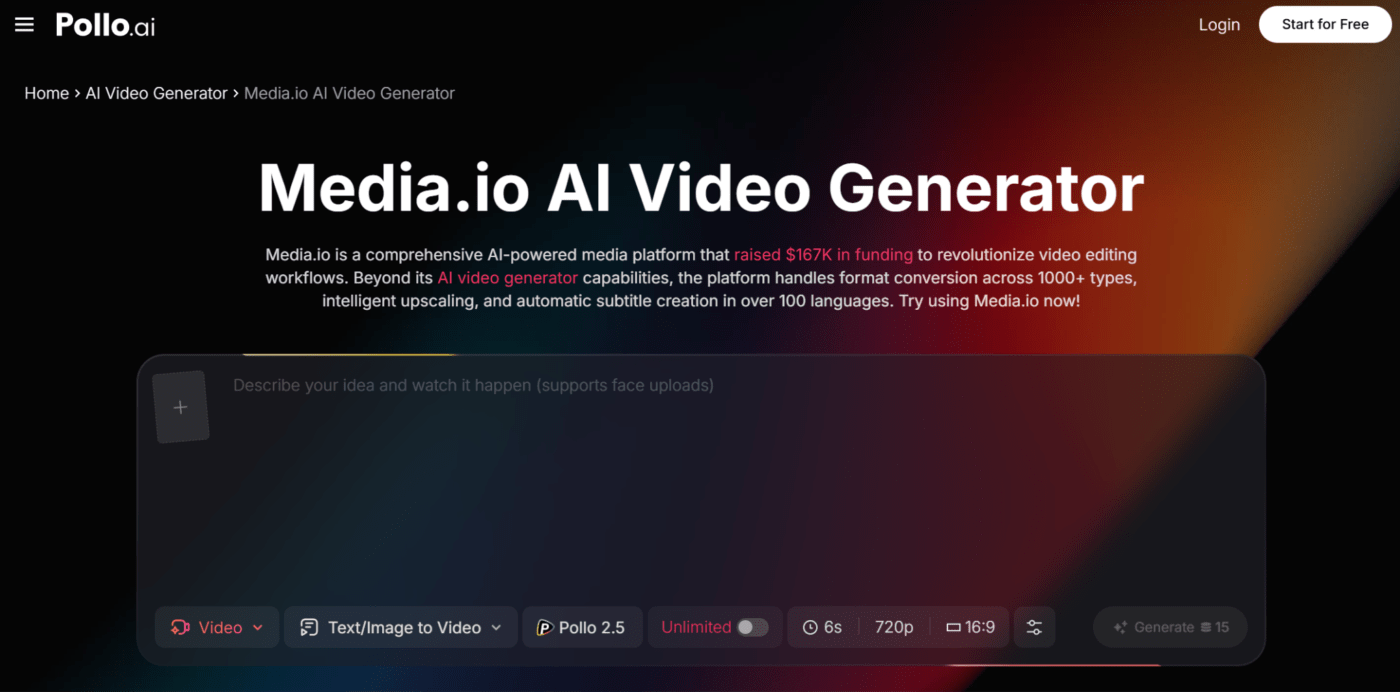
Media.io takes a versatile approach that appeals to creators who work across multiple content types, not just Instagram. It offers a solid suite of AI-powered editing features including background removal, audio enhancement, and format conversion, making it a useful all-around tool for anyone who produces content for several platforms simultaneously. Pollo AI provides access to Media.io’s capabilities, so you can explore its features alongside other editing tools without juggling multiple subscriptions. If you regularly repurpose Instagram content for other channels — pulling clips for Twitter, resizing for Pinterest, extracting audio for podcasts — Media.io’s breadth is a genuine advantage.
CapCut remains the default choice for many Instagram creators, and for good reason. Its template library is enormous, its auto-caption feature works well, and its integration with TikTok’s ecosystem means it stays current with trending formats. The limitation is that its AI features, while improving, still feel more like enhancements to a traditional editor rather than a fundamentally different workflow.
InShot is another popular option, particularly for creators who do most of their editing on mobile. It’s fast, intuitive, and handles the basics well. Where it falls short is in more advanced AI capabilities — if you want intelligent scene detection, AI-generated transitions, or prompt-based editing, you’ll outgrow it quickly.
What sets Pollo AI apart in this comparison is that it functions as a comprehensive platform rather than a single-purpose editor. Beyond Instagram-specific editing, it serves as a free all-in-one AI image and video generator where you can create content from text prompts, images, or existing video clips. That flexibility means you can go from initial concept to finished, Instagram-ready Reel without leaving the platform — an efficiency gain that compounds over time.
Practical Tips for Getting Better Results With AI Editing
Even the best AI editor produces mediocre output if you feed it mediocre input. A few habits make a noticeable difference in the quality of your finished Reels.
Film with editing in mind. This sounds obvious, but it changes your behavior in subtle ways. Hold shots for a beat longer than feels natural — AI editors trim more effectively when they have extra footage to work with. Shoot in the best light available, because AI color correction can enhance good lighting but can’t rescue footage shot in near-darkness. And film vertically from the start rather than planning to crop horizontal footage later. Cropping always loses information, and AI can’t invent what wasn’t captured.
Write your captions before you edit, not after. When you know what the text overlay will say, you can time your cuts to match the reading pace. Most AI editors can auto-generate captions from audio, but writing them yourself gives you control over emphasis and phrasing that auto-generated text often misses.
Build a consistent style and stick with it. One of the biggest advantages of AI editing tools is their ability to apply consistent treatments across multiple videos. If you find a color grade, font, and transition style that works for your brand, save those settings and reuse them. Consistency is what makes an Instagram feed look polished, and AI makes consistency effortless once you’ve established your baseline.
Making AI Work for Your Content, Not the Other Way Around
The temptation with any powerful new tool is to let it drive your creative decisions. AI editors can suggest cuts, recommend music, and even generate entire video concepts from a text prompt. That’s impressive, but the creators who get the best results use AI as an accelerator for their existing vision rather than a replacement for having one.
The most effective workflow I’ve found is to start with a clear idea of what I want the finished Reel to communicate, use AI to handle the production mechanics, and then review the output with fresh eyes before posting. That review step is important — AI editors occasionally make choices that are technically competent but tonally wrong for your audience. A transition that works for a fitness creator might feel jarring on a lifestyle account. A caption style that suits comedy content might undermine a heartfelt post.
Think of AI editing the way you’d think of a very fast, very capable assistant who doesn’t know your audience as well as you do. Let it do the heavy lifting, but keep your hands on the steering wheel. Platforms like Pollo AI make that balance easier to strike because they give you both automation and manual control, so you’re never locked into a decision the AI made on your behalf.
The creators who are winning on Instagram right now aren’t the ones with the fanciest equipment or the biggest budgets. They’re the ones who’ve figured out how to produce good content consistently without burning out. AI editing tools have made that possible in a way that genuinely wasn’t realistic even a year ago, and the gap between early adopters and everyone else is only going to widen.