There is a surprisingly awkward stage between noticing a few silvery strands and deciding whether you actually want to colour them.
Maybe your greys are concentrated around the temples. Perhaps your parting suddenly looks lighter in photographs. Or you might simply like your natural grey most days but want a little more coverage for work, an event or the stretch between salon appointments.
None of that means you need to commit to permanent dye.
Grey hair is a normal part of aging, caused as hair follicles produce less melanin, and choosing whether to show it, soften it or cover it is entirely personal.
For anyone sitting firmly in the “not ready for permanent color” camp, temporary solutions can offer far more control. The trick is choosing the right format for your hair texture, amount of grey and daily routine.

1. Use a root touch-up powder for precise coverage
Powders are particularly useful when your greys appear in small, predictable areas, such as around the hairline, temples or parting. Rather than misting colour across a large section of hair, you can place pigment exactly where contrast is most noticeable.
This can be especially helpful if your hair is fine or your parting has become more visible over time. A powder finish may visually reduce that contrast without requiring you to saturate the hair.
For a more controlled approach, root touch up solutions by Laura Geller use a cream-and-powder format designed to build coverage over grey roots and sparse-looking areas, with the powder helping to soften and set the finish.
That kind of targeted application is also part of what appealed to actress Didi Conn of famous series Grease. Conn while speaking to People Magazine has spoken about embracing ageing while still preferring her grey roots to blend with the soft brown colour through the rest of her hair, especially when visible regrowth appears before an event or last-minute plan.
Her experience is a useful reminder that temporary coverage does not have to mean hiding every sign of grey. It can simply offer more control over where and when you want to soften contrast, particularly around the part or hairline.
The best technique is usually restraint.
Begin with less product than you think you need, press or stipple it into the visible root area and build gradually. Dragging a heavily loaded brush through the hair can make the finish look flatter and more obvious.
Founder Laura Geller has also framed the product around the practical needs of mature consumers, including grey coverage, thinning-looking areas and sparse brows. That positioning fits neatly with a broader pro-age approach to beauty: the goal is not to erase change, but to give people more options in how they want to present themselves day to day.
Quick routine upgrade: If you only have five minutes before work or an evening out, concentrate coverage at the parting and front hairline first. Those high-visibility areas can make the biggest visual difference without turning a touch-up into a full styling session.
2. Try a temporary root spray when you need broader coverage
A spray format makes more sense when grey is distributed over a larger section of regrowth. It can be faster than individually covering strands, particularly around the crown.
The trade-off is precision. Spraying too close to the scalp or applying too much in one pass can leave the roots looking heavy. Protect clothing, follow the product instructions and build coverage in fine layers.
Hair texture matters here too.
On curls or waves, moving the hair around after application may disturb the finish, so complete most of your styling first and treat root colour as one of your final steps.
Managing different hair textures is also a great reminder that styling routines work best when they respect the hair’s natural pattern rather than fighting it.
3. Keep a hair touch-up wand for stubborn individual greys
Sometimes the issue is not a full centimetre of regrowth. It is three wiry silver hairs at the temple that seem determined to catch every available beam of light.
A mascara-style hair wand or precision colour stick can make more sense in this situation because it coats selected strands rather than the surrounding hair.
Apply sparingly and allow the product to dry before touching the area. This is particularly important around the temples, where glasses, hands and hats may repeatedly brush against the hair.
Do not substitute ordinary mascara or another eye cosmetic unless its manufacturer specifically states that it is suitable for hair. Products should be used for their intended purpose and according to their own instructions.
4. Consider tinted dry shampoo for an all-over softening effect
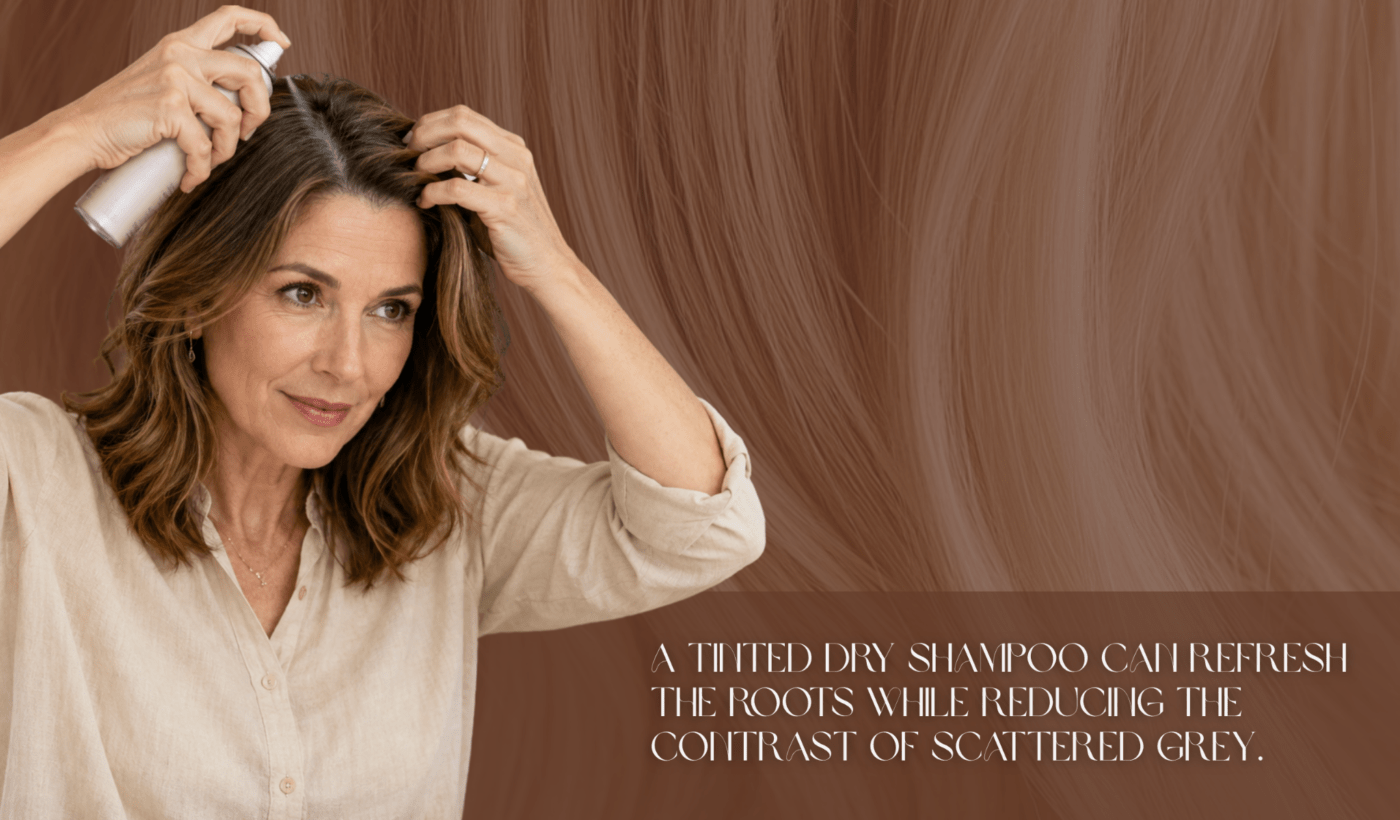
If your grey is scattered rather than forming a defined regrowth line, a tinted dry shampoo can create a softer effect.
It is less about painting every grey strand and more about reducing contrast while refreshing hair between washes. That makes it useful for busy mornings, travel and second-day hair.
Application is important. Use a light hand, give the product time to settle if directed, then distribute it carefully so concentrated pigment is not sitting in one spot.
If you already colour your hair, it is also worth being thoughtful about your wash routine, including how washing and styling habits can influence how colour-treated hair looks and feels.
5. Use a wash-out color treatment when the greys are more dispersed
Once grey strands are dispersed throughout the lengths, root-specific products become less practical. This is where temporary colour-depositing treatments can enter the conversation.
Depending on the formula, these products deposit colour without making the same long-term commitment as permanent dye, although “temporary” does not always mean the colour disappears after precisely one wash. Porous, lightened or very pale hair may retain pigment differently, so always check the manufacturer’s instructions and consider a strand test first.
If a product is classed as a hair dye, follow its safety directions carefully. The NHS notes that some hair dyes can cause skin reactions and advises following the instructions supplied with the product.
Make it easier on yourself: Test a new wash-out colour before the day you actually need it. You will learn how intensely your hair takes the pigment, how evenly it applies and how many washes it takes to fade.
6. Change your parting or hairstyle when you want zero pigment

The most temporary colour solution is technically no colour at all.
Grey often appears more noticeable where hair is repeatedly separated along the same line. Moving a centre part slightly to one side, adding soft volume at the roots or wearing hair in a textured style can break up a strong regrowth line.
Headbands, scarves and clips can also redirect attention when you want a styling solution rather than another product in your routine.
The important point is not to pull hair excessively tightly simply to hide a particular area. Styling should still feel comfortable. And if embracing your natural texture is part of the plan, your hair care as a self-care ritual offers a useful reminder that hair routines can be about enjoyment and confidence as much as appearance.
Temporary coverage should give you more choice, not another beauty rule
There is no deadline for deciding what to do with grey hair. You can cover your roots on Monday, leave them visible on Saturday and eventually choose permanent colour, or never choose it at all.
Temporary products are useful precisely because they keep those options open.
For isolated greys, choose a wand or precise powder. For a broader regrowth line, a root spray may be faster. For scattered silver through the lengths, a wash-out treatment may make more sense. And on days when you cannot be bothered with any of it, changing your parting may be all the intervention you need.
Choose the lowest-effort fix first: Match the size of the solution to the size of the problem. A small patch of grey rarely needs an all-over colour routine.
Keep permanent colour as an option, not an obligation: Experiment with temporary coverage until you know what makes your routine feel easiest and most like you.